Louisiana Divorce Timeline: How Long Does It Actually Take?
Louisiana requires 180 days living apart to divorce with no minor children, or 365 days…

Quick Answer: In Louisiana, almost everything you and your spouse acquire while married is jointly owned by both of you, no matter whose name is on the title or paycheck. That is the community property rule. It applies automatically when you marry in Louisiana (or move here married), affects how property gets divided in a divorce, and is one of the biggest differences between Louisiana family law and most other US states.
If you live in Baton Rouge or anywhere in Louisiana, the property rules that apply to you and your spouse come from the Louisiana Civil Code, not from common-law tradition. That difference matters more than most newly married couples (or newly relocated spouses) realize.
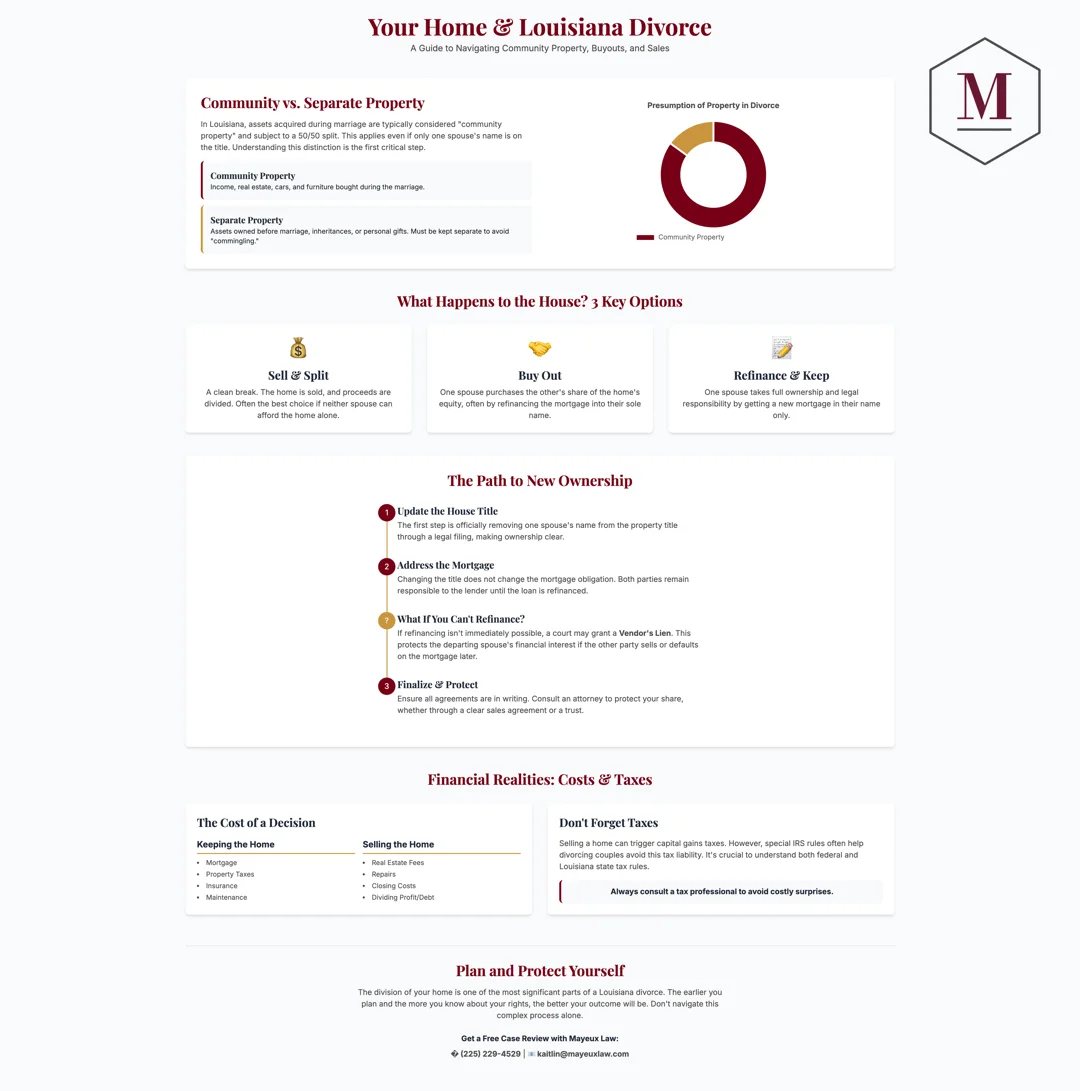
Most US states follow common-law property rules, where what is yours stays yours unless you intentionally combine it with your spouse. Louisiana flips that default. Unless you sign an agreement saying otherwise, what either of you acquires during marriage usually belongs to both of you.
Have questions about community property in your specific situation? Mayeux Law Firm focuses on Louisiana family law and the civil-law framework that governs it. Schedule a consultation with Kaitlin Mayeux for case-specific guidance.
The United States has two property law systems for married couples. Louisiana follows the civil-law tradition (inherited from French and Spanish legal systems). Most other states follow the common-law tradition (inherited from English law).
Under common-law rules, each spouse keeps their own income and assets unless they actively put both names on the title or commingle the funds. Under community-law rules, the assumption flips. Income and property acquired during marriage are presumed to belong to both spouses equally, regardless of how the title reads or whose paycheck deposited the money.
Per the Louisiana Civil Code, Title VI on the Matrimonial Regimes, the default regime in Louisiana is the “legal regime of community of acquets and gains.” That technical term translates to “community property” in plain English. It applies automatically the moment two people marry in Louisiana, or the moment a married couple establishes a domicile in Louisiana.
Nine US states follow community property rules: Arizona, California, Idaho, Louisiana, Nevada, New Mexico, Texas, Washington, and Wisconsin. The details differ between them. Louisiana’s version draws more directly from civil-law tradition than the other eight.
The simplest mental model: anything earned, bought, or acquired during marriage is presumed to be community property. Anything you brought into the marriage, or that came to you personally during marriage from outside the household, is presumed separate.
The table below covers the most common categories.
| Category | Default classification | Why |
|---|---|---|
| Paychecks earned during marriage | Community | Income from either spouse’s labor during marriage |
| House purchased during marriage (regardless of whose name is on the deed) | Community | Acquired during marriage with community funds |
| Business started during marriage | Community | Acquired during marriage |
| Retirement account contributions during marriage | Community (the portion earned during marriage) | Earned income contributed during marriage |
| Inheritance received during marriage | Separate (yours) | Inherited individually, not earned together |
| Gift to you specifically during marriage | Separate (yours) | Gifted individually |
| Property you owned before the marriage | Separate (yours) | Pre-marriage acquisition |
| Personal injury settlement (the part for pain + suffering) | Separate (yours) | Compensation for individual harm |
| Personal injury settlement (the part for lost wages) | Community | Wages that would have been community |
| Lottery winnings during marriage | Community | Acquired during marriage |
| Debts incurred during marriage | Community (both spouses responsible) | Same default rule applies to liabilities |
The defaults can be modified by agreement (prenup or postnuptial) and by careful documentation. They can also be muddled by commingling, which means mixing separate and community funds in a single account in a way that can make the separate portion difficult to prove later.
Most of the confusion about community property comes from common-law assumptions that do not apply here. The five below are the ones we see most often in consultations.
In a common-law state, that would usually be true. In Louisiana, what matters is when and how the property was acquired, not whose name appears on the document. A house purchased during marriage with paycheck income is community even if only one spouse signed the deed.
No. Income earned during marriage is community in Louisiana regardless of which spouse earned it. A stay-at-home spouse has an equal claim to the working spouse’s income earned during the marriage.
The opposite. Inheritance is presumed separate property and stays with the inheriting spouse, as long as it is not commingled with community funds. If you deposit an inheritance into a joint account and then use it for community expenses, you can lose the separate-property tracing.
Debts incurred during marriage are generally community, meaning a creditor may pursue community assets to satisfy them. There are exceptions (debts for one spouse’s separate purpose, intentional torts), but the default is shared.
The Louisiana classification is set at the moment of acquisition. By the time of divorce, the classification has already happened, even if neither spouse thought about it. Trying to reclassify after the fact is much harder than handling it through a prenuptial agreement before the wedding or a careful matrimonial agreement during marriage.
When a Louisiana marriage ends, the community property has to be divided. Under the default rule, division is equal: each spouse receives 50 percent of the net community estate.
The process generally works like this:
That sounds simple. In practice, it is rarely simple. Disputes about classification (especially around businesses, retirement accounts, real estate, and commingled accounts) often dominate Louisiana divorces. Tracing separate property that has been mixed with community funds requires careful financial records, often going back many years.

This is why Louisiana divorces with complicated assets benefit from real legal expertise. The classification step alone can be worth tens or hundreds of thousands of dollars to the spouses involved. For a broader look at the divorce process, our Louisiana divorce guide walks through fault and no-fault grounds and how a Louisiana divorce actually proceeds.
Community property does not cease to matter when a marriage remains intact. It also shapes what happens when one spouse dies.
When a spouse dies during the marriage, the surviving spouse retains their share of the community property. The deceased spouse’s half passes through the estate plan (will, trust, or intestate succession if no will exists). This differs from common-law states, where the deceased spouse can usually dispose of their separately titled property entirely, subject only to a smaller “elective share” for the surviving spouse.
For couples planning their estates, Louisiana community property requires careful coordination between the matrimonial regime, the wills, any trusts, and the choice of executors. A common pitfall: a will that “leaves everything to the children” can only actually leave the deceased spouse’s half of the community, not the survivor’s half. The surviving spouse keeps theirs by operation of law.
If you and your spouse have substantial community assets or own businesses or real estate, talking to both a family law attorney and an estate planning attorney about how your matrimonial regime affects your succession plan is worth the time.
Want clarity on what’s community vs. separate in your specific case? Kaitlin Mayeux focuses on Louisiana family law and the matrimonial-regime questions that come with it. A consultation is the fastest way to get a clear picture before you make decisions.

Most married Louisiana residents never need to think about community property in detail. The default rules work fine for everyday financial decisions.
The situations below are the ones where consulting a Louisiana family law attorney is worth the time and cost:
The earlier in the process you get clarity, the cheaper and easier the outcome usually is. Trying to sort out community vs. separate classifications years later, especially after commingling has occurred, is often the most expensive part of a Louisiana divorce.
These are the questions Baton Rouge spouses ask when they first realize the rules are different here. If you are wrestling with whether something in your marriage is community or separate, the section below probably covers your specific situation.
Yes, if you and your spouse establish a Louisiana domicile. The matrimonial regime that applies is determined by where the spouses are domiciled, not where they were married. A couple who marries in Texas and then moves to Baton Rouge becomes subject to Louisiana community property from the date of the move forward, even though Texas is also a community property state with somewhat different rules.
Property owned by either spouse before marriage is separate property and stays with the original owner. The asset itself stays separate even after marriage, but any income it generates during the marriage may be community depending on the type of asset. Rental income from a pre-marriage rental property, for example, can become community while the property itself remains separate.
Yes. Louisiana allows spouses to opt out of the community property regime entirely through a prenuptial agreement under Civil Code Article 2329. The agreement has to meet specific Louisiana formal requirements (notarized, signed by both parties, and recorded). It can establish a separation-of-property regime, a modified community regime, or other custom arrangements. A Louisiana family law attorney can draft an agreement that fits your specific situation.
If a spouse intentionally hides community assets during the marriage and those assets are discovered during or after divorce, Louisiana courts can revisit the partition. The discovery spouse may be entitled to a greater share of the recovered assets, plus attorney fees in some cases. Documenting suspicions early, working with a family law attorney who handles financial discovery, and being thorough during the disclosure phase of a divorce all matter.
Federal and Louisiana state taxes can be affected by community property classification, particularly for couples filing separately or in situations where one spouse has substantial separate income. The community property rules for tax purposes do not always align exactly with the family law rules. Talking to both a Louisiana family law attorney and a Louisiana CPA can save significant money on filings.
The same default rule applies to both. Debts incurred during marriage are presumed community, meaning both spouses can be held responsible regardless of which spouse signed for the debt. Creditors can pursue community assets to satisfy community debts. As with assets, separate debt (debt for the separate purpose of one spouse, or debt clearly classified as separate) is the exception, not the rule.
No. Louisiana community property applies only to legally married spouses. Unmarried couples in Louisiana do not acquire community property rights through cohabitation, no matter how long they live together. Property rights between unmarried partners arise from contract, ownership documents, and general civil law principles, not from the matrimonial regime.
The information in this post is general legal information about Louisiana family law, not legal advice for any specific situation. Reading this post does not create an attorney-client relationship. For advice on your specific case, schedule a consultation with Mayeux Law Firm at (225) 229-4529 or through the contact form.
Louisiana community property questions in your specific situation?
Kaitlin Mayeux focuses on Louisiana family law, including the civil-law matrimonial regime that governs community property. Whether you are planning a marriage, considering a prenup, or navigating a divorce, an early consultation gives you clarity before decisions get locked in.
Call (225) 229-4529 to talk through your situation, or schedule a consultation online.

Stay up to date with the latest family law insights, tips, and updates from Mayeux Law. Sign up for our newsletter today and get valuable information delivered straight to your inbox!